For two weeks in early 2025, if you looked at the promotional map Santa Barbara County wineries were building together, Lompoc wasn't on it. Not because nobody made wine here. Because the city council said no to paying into it.
That single vote tells you more about the Wine Ghetto than any tasting notes ever will. This is a wine district that has spent almost three decades treating outside promotion as optional, sometimes as something to actively refuse, and the instinct that produced that January 2025 vote is the same one now driving a lawsuit against the county in 2026. If you live here and drive past the industrial park off East Chestnut a few times a month without really registering it, the story underneath is worth fifteen minutes.
A warehouse became a wine district because nobody asked permission
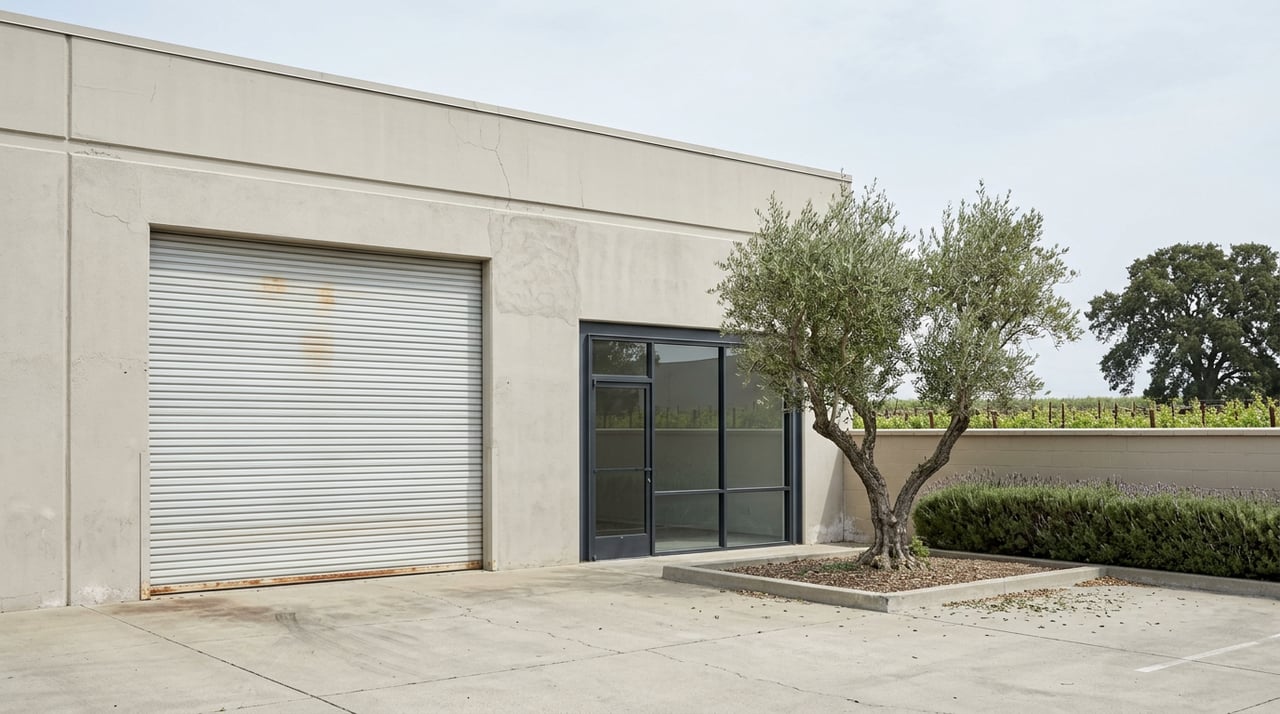
Rick Longoria founded his winery in 1982, but the Wine Ghetto as residents know it started in 1998, when he moved production into a warehouse in Lompoc's Sobhani Industrial Park. He wasn't chasing scenery. He was chasing rent he could afford and a building he could actually use. Other small producers followed for the same reason: low overhead, shared equipment, no obligation to build an estate tasting room to look legitimate.
The first tasting room in the park didn't open until 2005, seven years after Longoria arrived. By then the collaborative habit was already baked in. Winemakers here talk about learning from each other during harvest, about the late nights when having a neighbor in the next unit doing the same work makes the work easier. That's not marketing copy. It's how a cluster of production facilities off Chestnut Avenue and Chestnut Court turned into a wine district with more than 20 labels and roughly a dozen tasting rooms, all inside a two-block industrial footprint most visitors would drive past without a second look.
The city itself has a related habit. Lompoc launched its own municipal electric utility in 1923 rather than wait on inconsistent county service, and it became the first jurisdiction in Santa Barbara County to invest in geothermal and hydroelectric power. Self-sufficiency isn't a new personality trait here. It predates the wine industry by 75 years.
The vote that pulled Lompoc off the map
In January 2025, the Santa Barbara County Vintners Association was building a new Wine Business Improvement District, a county-wide marketing fund supported by a 1 percent assessment on direct-to-consumer wine sales. Solvang, Buellton, Guadalupe, and Santa Maria signed on. Lompoc's council voted it down on January 21, with Kathleen Griffith of Flying Goat Cellars telling the council that Lompoc deserved to be the only city in the county without a wine tax and that the promotional message alone would attract business.
The consequence was immediate and specific. Alison Laslett, CEO of the Santa Barbara County Vintners Association, told the Solvang City Council that wineries in a city that opted out would be left off the county's wine maps and marketing materials entirely. Lompoc, in her words, would put the county's wine country map to an end at the Santa Rita Hills.
Two weeks later, the council reversed course. In a special meeting, members voted to opt in after all, with the city adding a provision for an independent annual audit of the fund. Mayor Jim Mosby framed it as wanting accountability if the city was going to invest. Longoria winemaker Eric Wilson argued the opposite case that had won out: Lompoc is a world-class wine region and should want to promote that.
Griffith had been here before. In 2020 she led a successful fight against a nearly identical BID proposal, and it never got built. Two attempts, five years apart, same objection: a mandatory tax on small businesses to fund a marketing budget they didn't design and can't easily opt out of.
The lawsuit picks the fight back up
By June 2026, the disagreement moved from the council chamber to court. The Goldwater Institute, an Arizona law firm that takes on cases involving compelled speech and association, filed suit against the Santa Barbara County Board of Supervisors and the vintners association on behalf of Flying Goat Cellars. Griffith and her co-owner, Norm Yost, argue the mandatory 1 percent assessment violates their constitutional right to free speech and free assembly. Flying Goat has been making wine in Lompoc for about 25 years.
The Wine BID had been endorsed by 126 wineries, roughly 60 percent of the county's total wine sales, and was projected to fund a $1.5 million annual marketing campaign for the vintners association. Part of what that campaign covers: business trips to South Korea and Japan to build overseas sales for the county's wine brand. Flying Goat's owners have said, in their filing, that they'd rather put that same money into direct marketing with the customers who actually walk through their door.
That's the real fault line. It isn't a dispute over whether Santa Barbara County wine is good. It's a dispute over who gets to decide how a small, owner-operated winery spends its own margin, and whether a countywide majority vote can require a holdout to fund a campaign built around a strategy the holdout doesn't believe in.
What's actually new down at the Ghetto
None of this has slowed down what's happening inside the tasting rooms. The roster of labels working out of the industrial park reads like a list built by winemakers, not by a marketing department: Ampelos, Fiddlehead, Flying Goat, Sandhi, Tyler, Windrun, Chanin, Pali, alongside Longoria, whose Lompoc tasting room still runs a Friday happy hour from 4 to 7 p.m. at 415 East Chestnut Avenue.
One of the more distinctive additions in recent years is Camins 2 Dreams, founded by Tara Gomez, a member of the Santa Ynez Band of Chumash Indians, and Mireia Taribó, who trained in Catalunya. Their focus is cool-climate Syrah and Grüner Veltliner, fermented with natural yeast and minimal sulfites, sourced from Sta. Rita Hills vineyards farmed organically or biodynamically. Their tasting room at 1520 East Chestnut Court is open Friday from 1 to 6 p.m., Saturday from noon to 6 p.m., and Sunday from noon to 5 p.m., and well-behaved dogs on a leash are welcome.
A few practical notes if you haven't wandered through in a while:
- Most tasting rooms cluster their hours around Thursday through Sunday, with a handful open Monday. Weekday visits tend to be quieter.
- There's no restaurant inside the Ghetto itself. Locals typically bring lunch or grab something nearby before tasting.
- Several rooms are appointment-only, so a quick call or a check of a winery's own site before you go saves a wasted trip.
None of these businesses are chasing the aesthetic of Solvang or the Santa Ynez Valley's postcard vineyards. The buildings are still industrial. The parking is still tight on weekends. That's not an oversight. It's the same decision Rick Longoria made in 1998, repeated by every winemaker who's followed him into a warehouse instead of an estate.
What it means if you live here
The city counted 72 distinct wine brands registered within its limits as of 2025, most of them boutique and owner-operated, according to Edible Santa Barbara. That's a lot of small, independent decision-makers concentrated in one place, and it explains why Lompoc's relationship with countywide promotion keeps producing the same friction. A marketing budget built around exports and international recognition serves a large estate winery with volume to spare. It serves a boutique producer bottling a few thousand cases a year out of a converted warehouse differently, and sometimes not at all.
If you've watched the Wine Ghetto for a while, this isn't a story about wine tourism. It's a story about a district that keeps choosing to build its own reputation on its own terms, whether that means turning down a marketing assessment twice or opening a tasting room with a philosophy nobody else in the county is running. The character that makes the industrial park worth a Friday evening walk is the same character that makes it hard for outsiders to fold neatly into a countywide campaign.
That's not a flaw in the Wine Ghetto. It's the whole reason it exists.
If you're curious how a neighborhood's personality, from its wine district to its housing stock, shapes what it's actually like to live here, James Gallegos has spent decades working the Central Coast from Santa Barbara to Paso Robles and knows Lompoc's particular way of doing things. Let's Connect.